Activism
Stigmatising Dissent — A Response to J. Oliver Conroy
Threatening speech when it actually did not do so delegitimizes speech that epitomizes exactly the type of speech that is supposed to be protected.

Editor’s note: this is a reply to an article published on October 29 titled Get on the Bus or Get Under It: Shouting Down Free Speech at Rutgers by J Oliver Conroy. In the spirit of constructive disagreement we have published this formal reply here, but it will also be posted at the Heterodox Academy. If you would like to join the debate please email [email protected].
Can a threat to free speech masquerade as a defense of free speech? We believe it can, if that self-styled defense denounces and stigmatizes legitimate dissent by unjustly framing it as illegitimate. Just as a false accusation of abuse or harassment can itself be a form of abuse or harassment, falsely tarring dissent as a threat to speech when it is not can itself be a threat to free speech.
Unfortunately, many people seem to be highly sensitive to such threats from their political opponents and entirely tone deaf to such threats from their political compatriots. When someone on the Right condemns leftwing threats to speech, they may be correct to do so, but unless they also condemn similar threats from the Right, their defense of free speech is political, not principled.
When someone on the Left condemns rightwing threats to speech, they may be correct for doing so, but unless they also condemn similar threats from the Left, their defense of free speech is political, not principled.
We are not leftist apologists. Lee Jussim has a long track record contesting leftist biases in the social sciences. He is a founding member of Heterodox Academy, and has been featured in Quillette regarding the accuracy of stereotypes, the ballpark accuracy of Damore’s Google Memo and he has a book that just came out exposing a broad array of leftist biases in the social sciences. He also helped Spiked arrange the event at Rutgers which we discuss below. Akeela Careem is working with Lee on a variety of projects involving dissent and speech, and assisted in the Spiked event that is at the center of this essay.
Spiked is a British online current affairs magazine that bills itself as a champion of intellectual risk-taking liberty, and free speech. The tour of American campuses organised by the magazine had been called “Unsafe Spaces” as an intentional provocation – a proverbial poke in the eye to leftist academics and, especially, those students who appear to be so opposed to engaging with controversial ideas that they are willing to shut down others’ right to speech. Their ‘Unsafe Space,’ then, stands in contrast to university “safe spaces,” which are supposed to be where people, usually students, can go to avoid feeling threatened by exposure to views different to their own.
However, safe spaces are not as simplistic as they seem. From a progressive standpoint, students, especially those from historically stigmatized or marginalized groups, are frequently subject to hostility and even harassment. As a result, this view suggests they are not actually free to express their views, which may differ strongly from mainstream views. At minimum, they do not feel free to do so, and need spaces (physical or intellectual) where it is safe to express their views.
The concept that a socio-political environment should be created that permits most people to express their ideas without fear of insult or harassment is not a ridiculous idea. Note that we said “most” not “all.” Karl Popper, in The Open Society and Its Enemies (p. 543), drawing on Plato, pointed out the paradox of freedom: “freedom in the sense of absence of any restraining control must lead to very great restraint, since it makes the bully free to enslave the meek.” Thus, even bedrock human rights, such as that to free speech, must have some limits in order to actually maximize the free exchange of ideas, including but not restricted to political protest. Although the U.S. government cannot prohibit expressions of even perspectives some consider vile or ridiculous, your right to free speech does not entail a requirement that anyone else take you seriously. We personally feel no particular need to seriously engage with violent extremes, such as white supremacy, Nazism, Marxist totalitarianism, or advocacy for subjugation and mass murder. We similarly feel no need to engage with flat earthers, anti-vaccination advocates, or people who believe the world is 6000 years old.
Our hope is that by not wasting effort on the most absurd and reprehensible views, we can inspire thoughtful engagement on serious but controversial topics, such as affirmative action, policing, human evolution, and understanding sources of inequality. A person who opposes the preferential selection version of affirmative action, or who argues that police racism is not a major cause of disproportionate incarceration of African Americans, or who argues that valuing marriage, hard work, and civility are important ingredients in personal success, may or may not be right. But the act of making those arguments does not mean they are a racist, White supremacist, Nazi, or sexist.
Spiked’s Unsafe Spaces tour doesn’t provide an outlet for extreme views. Rather, it challenges audience members to listen. The format brings together panelists of academics, lawyers, and activists to discuss a variety of controversial topics, such as identity politics, political correctness, and why evolution is true. It is highly interactive, with only brief introductory comments by the panelists after which the floor is open to the audience for questions and comments, the idea of which is to then provide an avenue for extended, thoughtful engagement with these ideas between the audience and the panelists.
 Angel Eduardo
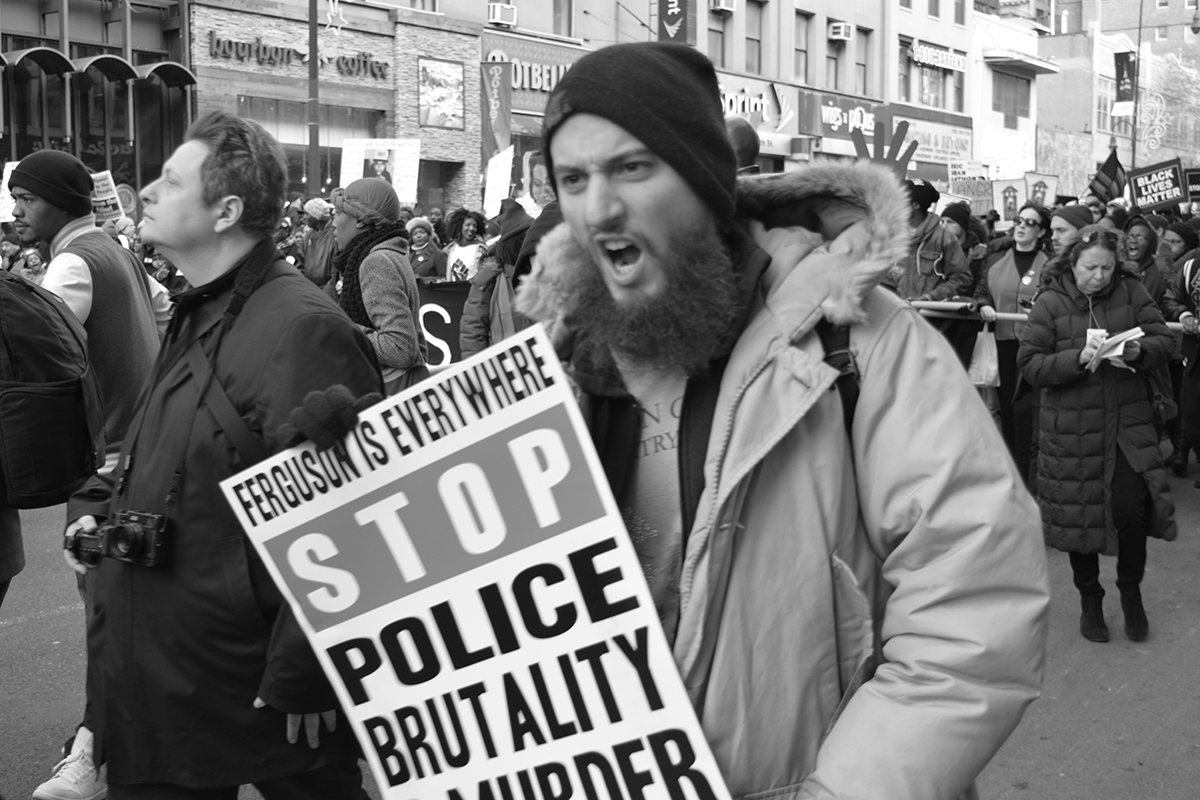
On October 2, Spiked hosted an Unsafe Spaces event on Identity Politics at our home institution, Rutgers University. The panelists were quite diverse (Kmele Foster, a black libertarian entrepreneur; Sarah Haider, who leads Ex Muslims of North America; Brian Stascavage, a former military intelligence analyst and current student at Wesleyan University; Mark Lilla, a Columbia humanities professor). The event was undeniably raucous. However, “raucous” is not equivalent to “shutting down” free speech. Instead, our view is that attempts to delegitimize protest that does not shut down free speech by claiming it does are themselves a far more serious threat to speech than those they condemn.
An article about this event written by J. Oliver Conroy appeared in Quillette, which routinely posts thoughtful essays on all sorts of controversial topics. This article was titled, “Get On the Bus or Get Under It: Shouting Down Free Speech at Rutgers.” Its tone conveyed the impression that the event was conducted under almost police-state conditions, and, as per the title, that speech was “shouted down.”
Here is what the article gets right about the event. There were police outside the event conducting bag checks as attendees entered, and there were several police in the event room, although we hardly noticed them, once the event started. The event also had moments when it was not clear that civility would be maintained, though, ultimately, it almost always was. It is definitely right in casting the activists who spoke as presenting strident and condescending monologues. Furthermore, there are so many real world cases where protestors are bona fide threats to campus speech and academic freedom that, in general, U.S. academic discourse needs more, not less, pushback against those threats.
Nonetheless, for us the problem is that this was not one of those cases. Here are some excerpts from the Quillette article, followed by our perspective indicating something not quite right about the factual claims:
The quiet suburb of New Brunswick, New Jersey, felt more like East Berlin, or Belfast, when I visited on the evening of October 2nd. The student center of Rutgers University had been transformed into a loose approximation of Checkpoint Charlie … visitors were screened by a gauntlet of police officers and security guards, who inspected our bags for weapons before allowing us into the building’s auditorium.
Of course there were police and security checks, as at any open-to-public event, including football games. It may even have been somewhat stronger than at other events of its kind. We do not know if calling the police presence a “gauntlet” and comparing security to a military checkpoint was meant to be literally true or simply overheated rhetoric. Our point is simply that these charged descriptions do not reflect our experience.
[I]t soon became clear that the protesters had no intention of listening to, or participating in, a debate. They were there to shut it down.
We agree with the first part. We saw little evidence of the “protesters” (a term that, as we will go on to explain, we reject as unfair) actually engaging with the speakers’ ideas. However, refusal to listen is not a threat to anyone’s speech. The second part – “there to shut it down” – is an inference about motivation that the author was not in a position to draw. Neither we nor Conroy can know what the intentions were. What we do know, however, is that no one actually shut down the event.
The first disruption set the template. A student stood up, interrupting a man who had raised his hand to ask the panel a question, and announced, “Before we get to that we’re gonna stop this little rhetoric here.” He then berated the panelists with a rambling indictment of structural oppression until the moderator finally cut him off.
This is a strange mix of truth and fiction, as is apparent from the video of the event, because it all takes place at about 25 minutes in. The supposed template was not set until about a third of the event had already taken place. At this time, a student did interrupt a man who had raised his hand, and did make the “rhetoric” comment, and he did want to continue. But the moderator and panelists quickly (within about 45 seconds) persuaded him to sit down and wait his turn. We also heard no “berating.” Was the interruption uncivil, even rude? Is it subject to criticism? Yes on all counts. There was, however, no “shut down” of speech. And that it set any sort of template is belied by the long stretches of uninterrupted back and forth between the panelists and the audience that followed.
Were it not for the heavy presence of police and security guards, it is entirely possible that the protesters at Rutgers would have stormed the stage and physically prevented the panelists from speaking, as recently occurred at William & Mary.
It is possible. Whether or not it would have actually happened in the absence of security is unknowable, but the audience displayed no evidence of being interested in violence. Our opinion is that such violence was unlikely mainly because, although there is some history of disruptive protest at Rutgers, there is no recent history of such violence of which we are aware. Was it good that security was there? For sure. Is the implication that the attendees intended to commit violence left unsubstantiated? Also for sure.
The Quillette essay then links these events to what it characterizes as the inherently intolerant nature of “intersectionality” – an issue we do not address here.

When is something a threat to free speech? The most obvious answer is when it actually attempts to prevent speech. There are ample examples from campuses around the country where leftist protestors have actually prevented speech through physical attacks, aggressive protests, and calls for retraction of controversial articles. A more subtle form of threat, however, comes from attempts to delegitimize speech through denunciations and condemnations.
The Left does not have a monopoly on such threats. President Trump’s call to challenge the license of NBC after its reports criticized him constitutes just such a threat. Attempts to ostracize or delegitimize kneeling football players – who are not burning flags, spitting at soldiers, or engaging in any behavior that disrespects or suppresses individuals, institutions, or symbols of America – are another.
Further, and most relevant here, the mischaracterization of protests as “shutting down” speech when they do not actually do so is yet another. The Quillette essay is wrong, but not because the facts reported are in error (though some are). It is wrong because it is a threat to legitimate expressions of dissent.
There was, in fact, no shut down of free speech, and we think even the term “protester” is unfair to those condemned by the original article. Their views differed from those of the panelists, but at no point did they try to prevent the panelists from speaking, or even object to the permissibility of discussing their views. Therefore, we refer to those who engaged in the more strident behaviors as “activists” rather than “protesters.” Here is a summary of what actually happened:
00:00:00 Moderator remarks.
00:04:55 Opening remarks by the four speakers.
00:24:47 Moderator invites audience questions.
Note the absence of disruption for these first 25 minutes.
00:25:07 Audience member about to ask a question.
00:25:08 Activist interrupts and starts speaking, (“we’re gonna stop this little rhetoric here” followed by moderator attempting to get him to wait his turn).
00:26:00 Activist returns to his seat to wait his turn.
00:26:01 A series of audience members (including the first activist) ask questions, sometimes in ways that challenge the panelists, but respectfully.
00:31:36 Foster responds to audience.
00:33:23 Activists start chanting “Black lives matter”; Foster responds with, “Has anyone here disagreed with that?”; raucous back-and-forth ensues between Foster and audience.
00:34:00 Activist steps in with a speech (which we would describe as a fairly incoherent leftist rant). Moderator and panelists let him have his say.
This was a serious interruption and we view it as crossing a line, because it did, temporarily, prevent Foster from finishing his statement.
00:36:00 Activist stops speaking, Foster resumes speaking.
Notice that this line was “crossed” for a grand total of two minutes, after which Foster did get to complete his statement. The audience member who stepped in at 00:34:00 was uncivil, but he did not, in fact, prevent anyone from speaking their mind.
00:37:41 Activist interrupts very briefly.
00:37:48 Foster resumes speaking, and other panelists respond, in turn.
00:46:45 Moderator invites more audience questions.
00:46:53 Audience members ask questions and make comments in an orderly manner.
00:52:11 Panelists respond to audience.
01:04:38 Moderator invites more audience questions.
01:04:53 Activist speaks, with an impassioned statement, plausibly interpretable as another “rant,” about imperialism, structural inequality, and racism.
01:05:30 Moderator tries to interrupt twice to move to the next question, but audience member keeps speaking.
Our view here is that the moderator prematurely interrupted the audience member, who, in fact, was not finished, and had been speaking for under a minute.
Keep reading

Last Man Standing
Claire's Weekly Letter: Naked in America
The Case for Elites with Richard Hanania | Quillette Cetera Episode 71
The $64 Question, Again